April 26, 2026 • Claire Merritt • 9 min reading time • Prices verified May 28, 2026
Farmers Market Totes That Look Good Enough to Leave on the Counter All Week
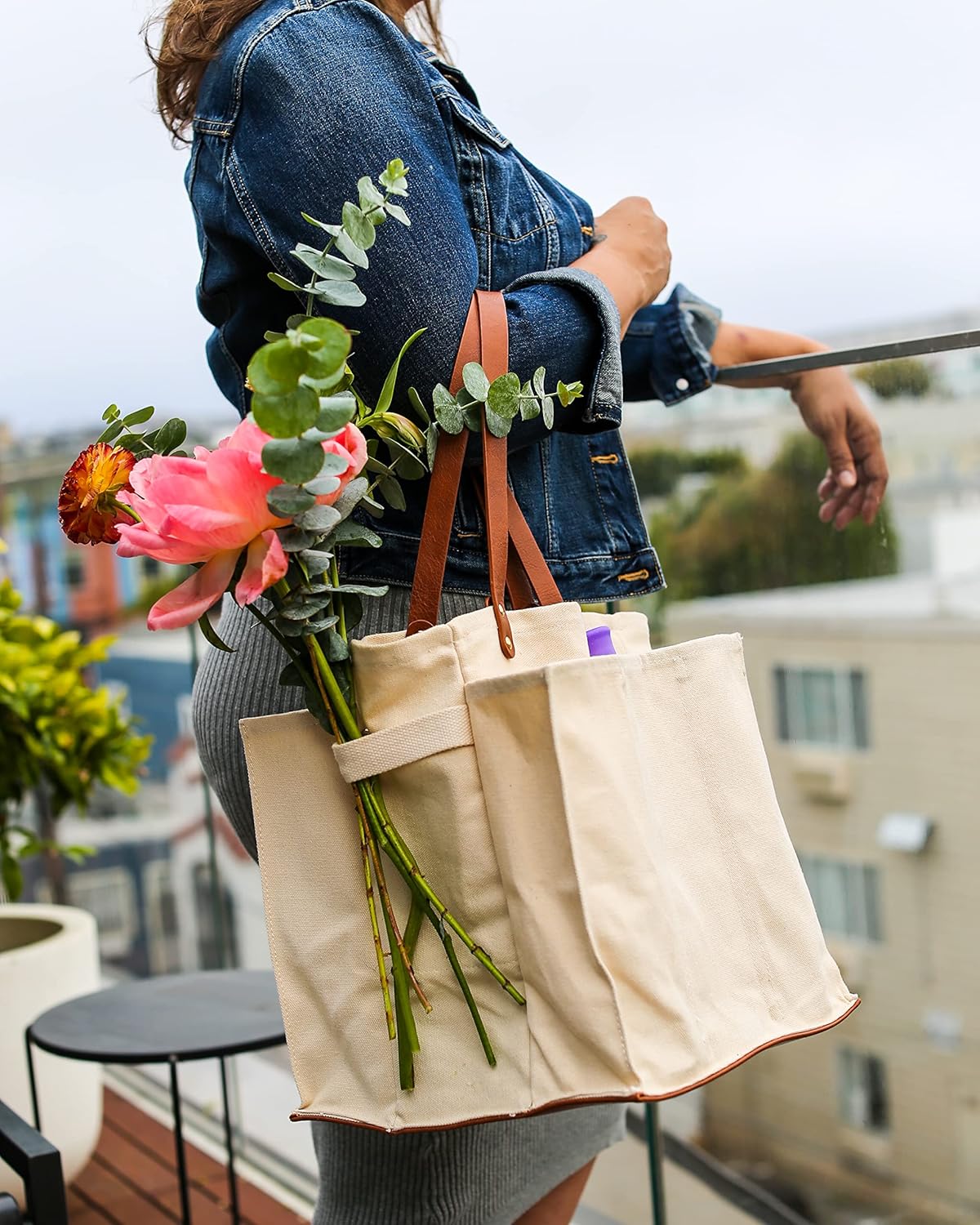
If you’ve ever hauled a dozen ears of corn, three jam jars, a bunch of kale, and a bunch of zinnias home from a Saturday market, you already know that most bags are not up to the job. Either they’re floppy, too small, and tip over the second you set them down — or they’re serious work-horse bags so aggressively utilitarian that you throw them in the closet the moment you get home. The best farmers market tote threads that needle: it carries a genuine load without complaint, and it looks at home on your kitchen counter, a dining table, or a coat hook all week long. In other words, you want a bag you’ll actually reach for again, not one you use twice and forget.
This guide is aimed at readers who have already cycled through a tote or two and now want to make a considered choice — whether that means spending $30 on a premium cotton canvas workhorse or $160 on something that pulls double duty as a market bag and a weekend carry-all. We’ll walk through the tradeoffs that matter: structure vs. collapse, material weight (measured in GSM — grams per square meter, the fabric-density number that separates a bag that lasts two years from one that lasts six months), strap design, and the all-important “does it look intentional on the counter” test.
Why Most Farmers Market Bags Fail by Month Three
Here’s the pattern across owner reviews and long-run reporting: bags that looked promising in the product photo fall apart at predictable failure points. Knowing those points in advance changes which specs you prioritize.
Strap attachment is the most common failure site. A strap that’s simply sewn onto a bag without a reinforced anchor — called a bartack (a dense cluster of stitches, essentially a patch of thread bolted to a stress point) — will eventually pull away from the body of the bag under a loaded haul. Look for bags where the strap is either woven through the body of the bag and stitched on the interior, or where the attachment point has a visible box-and-cross or bartack stitch pattern. Wirecutter’s reusable bag coverage consistently flags strap construction as the single biggest durability differentiator between bags at similar price points.
Canvas GSM is the second variable that separates the field. Cotton canvas marketed as “tote bags” ranges from about 8 oz (roughly 270 GSM) at the lightweight end — perfectly fine for dry goods, but prone to sagging under root vegetables and glass jars — up to 12 oz (approximately 400 GSM) and above for bags built to carry serious loads. At the farmers market, you’re frequently loading a combination of heavy root vegetables, glass jars of pickles or honey, and fragile produce simultaneously. That mixed load stresses fabric differently than a bag of flour. A 10–12 oz canvas keeps its structure under that load; an 8 oz bag will tent at the sides and put strain on the stitching at the base corners.
Base rigidity is the quiet variable nobody talks about in marketing copy. A bag that collapses when empty is annoying to load at a crowded market stand. A flat, reinforced base — either from a sewn-in cardboard insert, a stitched gusset, or a heavier base canvas panel — makes a bag faster to open and fill, less likely to tip, and significantly more pleasant to carry when the contents shift in transit.
By the numbers:
- 270 GSM (~8 oz canvas): light carry, dry goods, max practical load around 15–18 lbs before fabric stress
- 340 GSM (~10 oz): the sweet spot for mixed produce and glass; handles 20–25 lbs comfortably per manufacturer ratings
- 400 GSM+ (~12 oz): heavy-market and vendor-grade; rated loads at 30–40 lbs common; noticeably stiffer and more structured
The Aesthetic Question Is Actually Functional
Let’s be direct: the reason you’re reading a guide called “totes that look good enough to leave on the counter” is that a bag on your counter gets used. A bag in the closet doesn’t. There’s a genuine behavioral loop here — Good Housekeeping’s reusable bag reporting and The Spruce’s farmers market bag coverage both note that household adoption of reusable bags correlates heavily with storage visibility. Bags you see become habits; bags you have to hunt for become backups you grab when you realize you forgot everything else.
This has a practical implication for how to shop: treat aesthetics as a use-rate variable, not a vanity one. A bag you love looking at earns its price premium in reduced single-use bag consumption and sustained weekly use. The cost-per-use math genuinely favors the $80 bag you carry 200 times over the $15 bag you carry 20 times and toss. (Treehugger’s analysis of reusable bag lifecycle math consistently makes this case; the numbers move decisively toward premium options once you hit 50+ uses.)
That said, “looks good on the counter” covers different aesthetics for different kitchens. There are three broad design registers worth distinguishing:
Natural canvas neutral. Undyed or ecru heavyweight canvas with minimal branding. This is the current safe harbor — it reads as considered and intentional in almost any kitchen, from a white Shaker cabinet situation to a warmly cluttered maximalist space. Brands like Madewell’s canvas totes, Cuyana’s classic leather-trim market tote, and L.L.Bean’s Boat and Tote all live comfortably in this register. The tradeoff is that undyed cotton shows grime faster and needs occasional washing.
Structured leather-trim market bag. Bags like Cuyana’s large tote add leather handles and a stiffened top frame that give them a European-market-basket energy — the kind of bag that implies you also have strong opinions about which bread you buy. These are heavier, slower to throw open and fill, and significantly more expensive. Owners report they’re better suited to light-load, high-style outings than full-volume hauls, but that for many buyers, using them twice a week at a Saturday market justifies the price over three to five years of use.
Color-blocked canvas or waxed canvas. Brands like Baggu’s duck bag line and select seasonal offerings from Madewell bring color into the mix. The risk is trend sensitivity — a colorway that reads as fresh in 2026 may feel dated in 2029. Waxed canvas (canvas treated with paraffin or synthetic wax to create weather resistance) ages beautifully with use, developing a patina that looks better at month eighteen than at day one. It’s also easier to wipe clean than raw cotton, which matters after a jar of something leaks. The tradeoff is a slight waxy smell initially and a stiffer hand until the material breaks in.
Decision Framework: Which Tote for Which Situation
You’re choosing a farmers market tote in one of a few scenarios, and the optimal pick differs meaningfully:
If you’re an occasional shopper doing a single bag of light produce and flowers: A 10 oz cotton canvas tote in the $25–$50 range — the Baggu Duck Bag at around $38, the L.L.Bean Small Boat and Tote at about $30, or a Madewell canvas medium tote — handles this cleanly and looks presentable anywhere. Don’t overspend for volume capacity you won’t use.
If you’re doing a full weekly haul — root vegetables, glass jars, bread, flowers, mixed weight: Step up to a 12 oz canvas bag with a structured base and reinforced strap attachments. The L.L.Bean Large Boat and Tote (approximately $40–$50 depending on hardware configuration) is the editorial consensus pick here: owners consistently report multi-year durability under genuine load, and the monogramming option makes it a strong gift candidate. At the premium tier, Cuyana’s large classic tote (~$198) offers leather handles that distribute weight differently and hold up to sustained use without the fabric bunching that lighter bags develop.
If you’re a farmers market vendor or meal-prep practitioner carrying volume weekly: This is a different conversation — you need commercial-grade insulated totes for temperature-sensitive items, or high-volume canvas totes built closer to industrial standards. Look at Cotopaxi’s Allpa tote series for structured carrying and lo & sons OMG tote for a hybrid that functions at both volume and everyday use. Owners in vendor contexts report the Cotopaxi holds up to repeated heavy loading better than bags at its price tier; the key is the external frame structure and the weight distribution of the longer strap drop.
If you’re buying for a gift recipient (and the tote will live on their counter): Neutral is safer than bold. A large natural canvas tote with leather handles or a clean hardware fastening reads as a considered gift without imposing an aesthetic on someone else’s kitchen. The Cuyana classic tote or the L.L.Bean Large Boat and Tote with monogramming hit the $60–$150 gift range cleanly. Both have sustained owner satisfaction ratings across aggregated reviews — not a bag that lands with excitement and sits unused.
A Note on Washing and the “Counter Test”
The counter test — asking whether you’d leave this bag out all week — implies a certain tidiness standard. Canvas bags at the 10–12 oz range are machine-washable in almost all cases (check manufacturer care guides; most recommend cold water, air dry to preserve canvas structure and any leather hardware). Waxed canvas should not go in the machine — spot clean only, per care guidance from most manufacturers including Filson and similar waxed-canvas producers. Structured leather-trim bags need occasional leather conditioning on the handles; most makers sell or recommend a compatible conditioner.
The practical schedule most owners settle on: wash the bag every three to four market trips for raw canvas, wipe down waxed canvas after any wet produce or drips. At that maintenance cadence, a quality 12 oz canvas bag stays counter-presentable for two-plus years with zero visible degradation — and often improves in hand feel as it softens.
The If/Then Summary
- If your priority is pure durability at lowest cost: L.L.Bean Large Boat and Tote, ~$45, 12 oz canvas, bartacked straps, lifetime guarantee.
- If your priority is counter aesthetics and you’ll carry lighter loads: Madewell canvas tote or Baggu Duck Bag, $30–$45, 10 oz canvas, strong color and print options.
- If you want a bag that earns its price over five-plus years of weekly use: Cuyana Large Classic Tote, ~$198, leather-handle weight distribution, owners report strap integrity holding across 3–4 years of heavy use.
- If you’re a vendor or volume shopper: Cotopaxi Allpa or lo & sons OMG for structured carrying volume; add a separate insulated liner bag for temperature-sensitive items rather than trying to find one bag that does everything.
- If you’re buying as a gift: L.L.Bean Large Boat and Tote with monogramming or the Cuyana Classic — both hit the $60–$150 giftable range and land with sustained owner satisfaction rather than novelty that fades.
The bag on your counter is the bag you’ll use. Pick the one you’d be fine seeing every day — then make sure it can handle a full Saturday haul without straining at the seams.