May 22, 2026 • Claire Merritt • 9 min reading time • Prices verified May 28, 2026
Oversized Canvas Totes for Beach Days and Weekend Trips: Strap Strength and Real Capacity, Compared
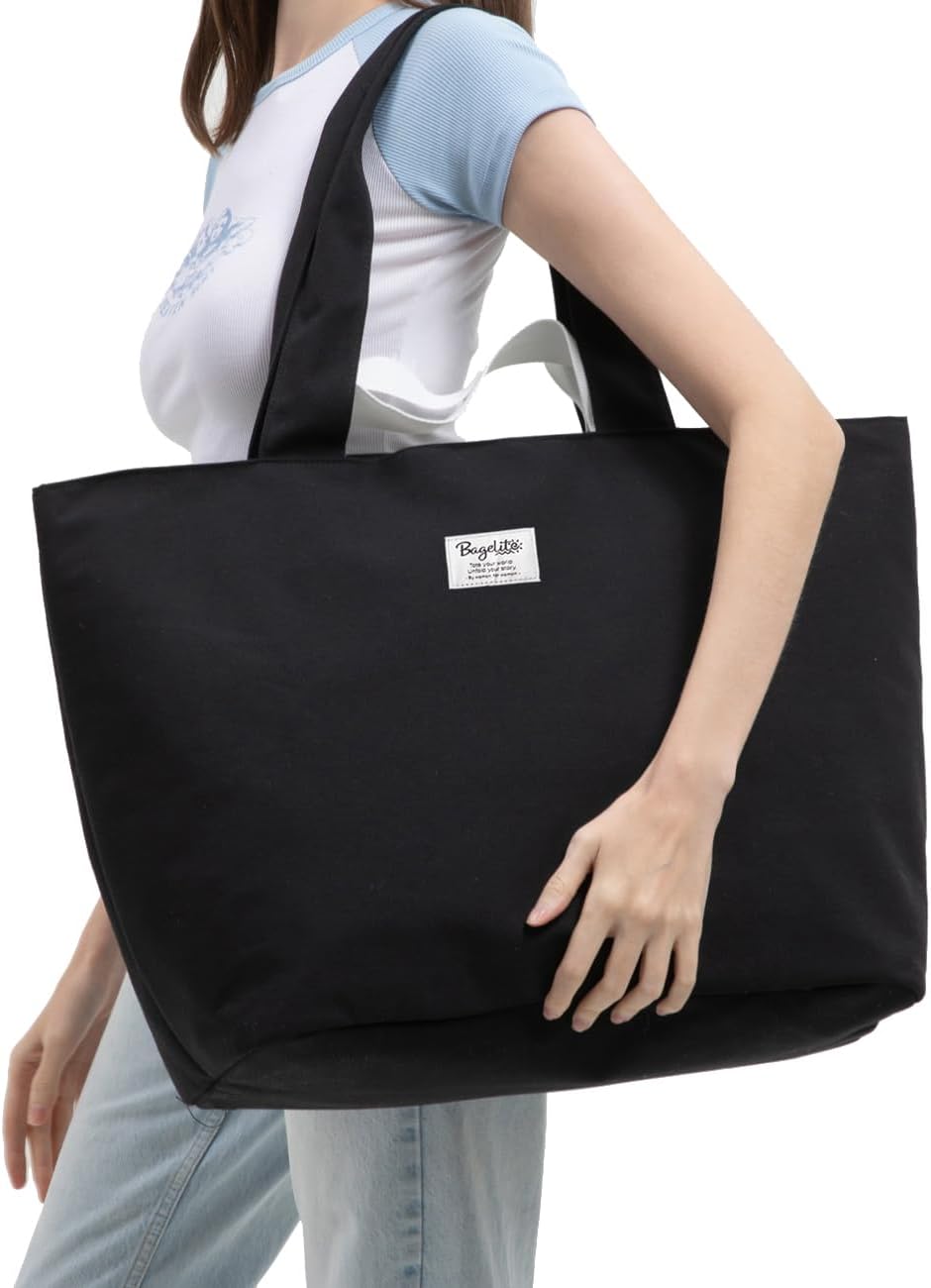
An oversized canvas tote is exactly what it sounds like: a large, open-top bag made from woven cotton or cotton-blend fabric, big enough to swallow a beach towel, a change of clothes, and everything you forgot to leave at home. The two numbers that matter most when you’re buying one are strap drop — that’s the distance from the top of the handle to the top of the bag, which determines whether the bag hangs at your hand, your elbow, or your shoulder — and load capacity, which is how much weight the bag can carry before seams start pulling, straps start fraying, or the whole thing starts to feel like a bad idea. Most brands advertise neither clearly, which is why so many people end up with a beautiful bag that digs into one shoulder on the walk from the parking lot to the sand. This guide cuts through that. By the end, you’ll have a framework for comparing any oversized canvas tote on these two axes, and a shortlist of bags that hold up.
| EDITOR'S PICKExtra Large Canvas Tote Bags wi… | Mid-tierDurable 100% Cotton 12oz Canvas… | Budget pick[KALIDI Beach Nylon Mesh Tote Bag](https://www.amazon.com/dp/B09VT1FCYN?tag=greenflower20-20) | |
|---|---|---|---|
| Capacity | — | — | 23L |
| Material | 100% Organic Cotton | 100% Cotton 12oz Canvas | Nylon Mesh |
| Zipper Closure | ✓ | ✗ | — |
| Washable | ✓ | — | — |
| Price | $24.99 | $11.99 | $9.87 |
| See on Amazon → | See on Amazon → | See on Amazon → |
Why Strap Drop Is the Spec Nobody Publishes (But You Feel Immediately)
Strap drop is the single most under-reported measurement in the tote category, and it has an outsized effect on how usable a bag actually is when it’s full.
Here’s the practical breakdown: a 10–12 inch strap drop means the bag hangs at roughly hand height. You’re gripping it, not resting it. For a quick grocery run, that’s fine. Load it with 20 pounds of wet towels and a weekend’s worth of clothes, and it becomes a workout. A 14–18 inch drop gets you to elbow or forearm carry — more natural for heavier loads over longer distances, which is exactly what a beach-parking-lot-to-shore walk demands. A 20–24 inch drop reaches the shoulder, which is the most comfortable position for sustained carry but requires the bag to be narrow enough that it doesn’t flop away from your body.
The problem is that most oversized canvas totes are wide. Wide bags on long straps pendulum off the shoulder the moment you start walking, which cancels out the ergonomic benefit. The sweet spot for a true weekend-trip tote — one you’ll carry from car to Airbnb to farmers’ market — is a 16–20 inch drop on structured, reinforced straps, ideally with some width at the handle to distribute pressure.
Where can you verify drop before you buy? Some retailers publish it in the product dimensions. L.L.Bean, for instance, lists handle drop on most of its Boat and Tote variants in the product specifications section of its website; the open-top large sits at approximately a 10-inch drop — practical for short carries, less ideal as an all-day bag without a strap extender. Baggu publishes strap drop figures for its canvas Duck Bag line on its product pages; at around 11 inches, those bags are better suited for shoulder-slung urban errands or a day trip than a heavily loaded beach trek. When a brand doesn’t publish drop at all, measure the product image against a stated dimension, or — better — look at owner reviews that describe carry position. Reviewers who complain that the bag “hits the side of my knee” are describing a short drop on a tall bag.
Load Capacity: Reading Between the Seams
Load capacity is where spec sheets get vague and owner experience gets specific. The question isn’t just how much a bag can carry in theory — it’s what happens to the stitching, straps, and fabric after carrying near-max loads repeatedly.
GSM — grams per square meter, the standard measure of fabric weight — is your first proxy. You don’t need to memorize a chart; just know that:
- 8–10 oz canvas (roughly 270–340 GSM): Light, foldable, great for supplemental use. These bags carry 15–20 lbs without immediate failure, but repeated heavy loads will stress the strap attachment points over months.
- 12–16 oz canvas (roughly 400–540 GSM): This is workhorse territory. The L.L.Bean Boat and Tote’s standard body fabric runs in this range, according to L.L.Bean’s published product specifications. Owners and long-run reviewers consistently report carrying 40+ lbs with no structural complaint, and the bags often outlast the owner’s decorating aesthetic.
- 18 oz and above: You’re now in heavy-duty waxed or military canvas, typically from brands like Frost River or Duluth Trading. These are the bags that get handed down.
The second proxy is bartacking — a dense, tight stitch cluster (it looks like a small rectangle of zigzag thread) placed at high-stress points like the top of strap attachment and the base corners. If you can see bartacking on a product image, the brand is thinking about load distribution. If the strap is simply sewn into the top hem with a single row of stitching, that’s your failure point under load. New York Times Wirecutter’s reusable bag roundup (“The Best Reusable Grocery Bags”) consistently flags strap attachment as the primary failure mode across budget and mid-tier canvas bags — a finding that aligns with what owners report across most major review platforms.
By the numbers:
| Canvas Weight | Typical GSM | Practical Load Range | Strap Durability Signal |
|---|---|---|---|
| 8–10 oz | 270–340 | 15–20 lbs sustained | Look for bartack or webbing backing |
| 12–16 oz | 400–540 | 25–45 lbs sustained | Bartack standard at this tier |
| 18 oz+ | 600+ | 50 lbs+ sustained | Full strap channel or rivets |
The Bags Worth Naming
A framework is only useful if it helps you make a decision, so here are the bags the evidence actually supports for beach-and-weekend use — evaluated against published specs and what owners report over multi-month use, not day-one impressions.
L.L.Bean Boat and Tote (Large or Extra-Large Open Top)
The Boat and Tote is the category reference point. According to L.L.Bean’s published product specifications, it’s made in Maine from 24-oz cotton canvas — substantially heavier than most competitors. The large open-top version offers a 10-inch handle drop, which limits its all-day shoulder-carry appeal, but owners consistently report hauling 40–50 lbs without strap failure, often for years. The structure is stiff enough to stand upright when loaded, which is a meaningful quality-of-life feature when you’re packing a car. It’s not the most stylish option in the category, but for pure load capacity and longevity, it sets the standard. The cost-per-use math is favorable if you’re buying once and using for a decade.
Madewell The Canvas Transport Tote (Large)
Madewell’s Transport Tote sits at the intersection of aesthetics and function that this category often misses. The canvas is lighter than the Boat and Tote — the brand doesn’t publish an explicit oz weight, but owner-reported feel and Good Housekeeping’s coverage of structured canvas beach bags describe medium-weight cotton construction as the right balance between packability and day-load durability. The strap drop sits at approximately 11 inches, placing it in elbow-carry territory. What owners flag most positively is the structured base, which prevents the floppy-bag problem that plagues lighter oversized totes. At the $50–$70 price point, it bridges the gap between weekend-trip practical and aesthetically cohesive. Good Housekeeping places structured canvas totes with reinforced bases in their recommended tier for all-day beach use, a finding this bag’s owner reviews support.
Baggu Extra Large Canvas Duck Bag
Baggu’s nylon bags are famous, but their canvas Duck Bag is a different product entirely: 12-oz duck cotton, flat bottom, two interior pockets, and a strap drop of around 11 inches per the brand’s published product page specifications. It’s not a shoulder bag at full load, but owners loading it with beach gear for a day trip — towels, sunscreen, a packed lunch, a book — report it handling 20–25 lbs comfortably with no strap complaint. The real advantage here is packability: it folds flat to almost nothing and weighs under a pound, which matters if you’re flying to a beach weekend and want a bag that lives in your duffel until you arrive.
Lo & Sons Catalina Deluxe Tote
Lo & Sons occupies the premium end of this analysis. The Catalina Deluxe is a structured canvas tote with leather handles, a zipper top (unusual in this category), and a strap drop that reaches true shoulder-carry length — approximately 20 inches. Owners in long-run reviews describe using it as an overnight bag substitute, not just a beach tote, which speaks to the interior volume and structural integrity. The leather handle trim draws the occasional report of wear at the attachment point after 12–18 months of heavy use, but the canvas body itself ages cleanly. At $200+, the cost-per-use math requires genuine frequency of use to justify, but for the reader who wants one bag that goes from airport overhead to beach to dinner, it’s the only canvas option that actually covers all three.
The Decision Framework: If X, Then Y
This is the purchase logic the spec sheets don’t give you directly.
If you’re carrying 30+ lbs over any distance longer than a parking lot: You need 12 oz canvas minimum, bartacked strap attachment, and a strap drop of at least 14 inches. The L.L.Bean Boat and Tote (large, with a strap extender if needed) is the unambiguous pick. The extra-heavy canvas means the bag stiffens slightly when cold and damp, which is a beach-bag reality worth knowing.
If you’re flying to the destination: Weight and packability come first. The Baggu Duck Bag packs flat, weighs almost nothing, and handles a day’s beach load without structural complaint. Treat it as your beach layer, not your travel layer.
If aesthetics are genuinely non-negotiable and you’re carrying moderate loads (15–25 lbs): The Madewell Transport Tote or Lo & Sons Catalina Deluxe both hold up under honest use and look intentional rather than utilitarian. The Madewell is the value call; the Lo & Sons is the investment if you’ll use it 150+ times.
If you’re buying as a gift for someone whose carry habits you don’t know well: The L.L.Bean Boat and Tote in a medium weight wins on versatility and reputation. It’s the one pick that functions across all use cases, comes backed by a lifetime guarantee, and lands well across style registers because it’s been a design constant long enough to read as classic rather than trendy.
The one thing worth resisting: the impulse to optimize for looks alone at the expense of strap construction. A beautiful bag with a single-stitched strap will start failing at the attachment point somewhere between months three and six under real load. The bags that look good at month twelve are the ones built for month twelve from the start.